| ||||||||||||||||||||||||||||||||||||||||||||||
Wednesday, October 9, 2013


Wednesday, July 17, 2013
Change the Direction of Your Ceiling Fan for Summer
What is the Proper Ceiling Fan Direction for Summer and Winter?
Like backyard barbecues and neighborhood pool parties, ceiling fans are often a summertime staple, but did you know you could use a fan to heat your home during the winter? You can by changing the fan direction.
Changing the direction of the ceiling fan alters the fan blade movement so the blades rotate counterclockwise in the summer and clockwise in the winter. This is an effective way to regulate comfort, reduce energy costs, and increase utility savings year-around. Adjusting a ceiling fan’s blade rotation is as easy as pressing a button or flipping a switch.
Here are some tips to help you determine the proper ceilign fan directon for each season.
Counterclockwise Fan Direction for Summer
Ceiling fans spinning a counterclockwise direction are a cost-effective way to increase your comfort during the summer. The counterclockwise fan blades push cool air downward, creating a wind chill effect that accelerates the evaporation of perspiration and makes a room feel up to four to eight degrees cooler without altering the temperature (see Figure 1). This allows you to raise the thermostat setting a few degrees, decreasing the use of the air conditioning unit and reducing energy consumption.
If spending time outside is the highlight of your summer, outdoor fans are great for remaining cool in your home’s exterior spaces such gazebos, patios, and porches. Exterior ceiling fans are designed to withstand outdoor elements like humidity, rain, snow, and water. Verify your outdoor ceiling fan is rated for damp or wet environments to ensure performance, longevity, and of course, comfort.

Figure 1
In the summer, fan blades move in a counterclockwise direction to push cool air downward.
In the summer, fan blades move in a counterclockwise direction to push cool air downward.
Five Reasons to Change Your Fan Direction for Summer
1. Enjoy the cooling wind-chill effect on your skin
2. Feel four degrees cooler without sacrificing comfort or style
3. Spend more time outdoors with family
4. Reduce central or window air conditioning use, utilizing less energy
5. Save up to 40 percent on air conditioning costs
Clockwise Fan Direction for Winter
Fans moving at a low-speed clockwise direction are an economical way to heat your home during the winter. The clockwise fan blades create a gentle updraft that recirculates the warm air that naturally rises to the ceiling with the cool air that sinks to the floor (seeFigure 2). This allows you to rely less on heating devices like space heaters or heating blankets, which may pose health and injury risks as well as the cost of heating fuel and materials.

Figure 2
In the winter, the blades move in a clockwise direction to pull cool air upward and push warmer air downward.Five Reasons to Winterize Your Fan
1. Stay warm and comfortable during the wintertime
2. Reduce clutter due to electrical appliances like space heaters
3. Decrease electric hazards and accidents due to heating blankets
4. Reduce the cost heating fuel and materials
5. Lower energy consumption up to 15 percent
In the winter, a ceiling fan spinning in a clockwise direction adds warmth to a bedroom, kitchen or living room. Parents may install a whimsical kid’s ceiling fan to ensure their children are comfortable and warm as they sleep throughout the evening.
How to Change the Direction of Your Ceiling Fan
Many manufacturers offer models with ceiling fan remotes with reverse to adjust the fan blade direction at the push of a button. However, if your ceiling fan does not have a handheld remote or wall control, you can easily change the blade rotation by flipping the direction switch on the motor housing in the opposite direction. Push the switch down for downward airflow in the summer. Push the switch up for an upward airflow in the winter. Change your ceiling fan's direction at the beginning of summer and winter seasons, here's how:
- Shut off the ceiling fan and wait for the blades to stop completely
- Obtain a ladder or step stool to reach the fan body
- Flip the directional switch on the motor housing
- Step down from the ladder or step stool and turn the fan back on
- Stand below the fan and verify blades are moving in the right direction

If the blades are rotating correctly for the season, you should feel cool air during the summer and no air movement during the winter. In addition, listen for odd noises and watch for any unsteadiness. Wobbling or shaking is a sign that a fan needs additional maintenance such as balancing. If you encounter any additional difficulties, see our troubleshooting guides with answers to common ceiling fan problems.
Benefits of Seasonally Changing Your Ceiling Fan Direction
Changing your ceiling fan direction is a cost-effective and energy-efficient way to cool and heat your home year-round without sacrificing your personal comfort. Some homeowners have reported an annual savings of $500; however, total saving may vary depending on your location, housing characteristics, and energy cost in your area. Select a new ceiling fan from our bestselling selection of remote controlled, reverse from the motor ceiling fans below.
Article Written by +Colby Harris
Sunday, June 16, 2013


Friday, June 14, 2013
IS HOUSING STILL AFFORDABLE?
| IS HOUSING STILL AFFORDABLE? |  | ||||||||||||||||||
| Interest rates are rising but historic buying opportunity remains | | |||||||||||||||||
|  | | | |  | | |||||||||||||
| What if mortgage interest rates suddenly rose above 5 percent? Would you still consider housing affordable? To answer that question, it helps to have some historical perspective. A decade ago, when 30-year mortgage interest rates hit 5.25 percent, homebuyers and homeowners rushed to take advantage of the lowest rates in almost 40 years. Many of those people had owned their homes since the mid 1990s when rates were in the 8- to 9-percent range. And some even remember the early '80s when rates were as high as 18 percent. Five and a quarter? That was practically free money. Then came the housing boom...followed by the bust...followed by the Fed's massive stimulus programs, all of which drove the average 30-year mortgage rate from 6.76 percent in June 2006 down below 5 percent in April 2009, below 4 percent in November 2011 and finally below 3.5 percent late last year. Supporting the community is a big part of @properties' business. Watch the video.  June marks the 38th consecutive month that 30-year mortgage rates have averaged less than 5 percent, and many people have been lulled into thinking that sub-5-percent mortgage rates are perfectly normal. They're not. Today, people are finally starting to sense the end of a historic period in housing finance. With both interest rates and home prices rising in tandem for the first time in a long time, it appears that affordability has peaked. That's no reason for would-be buyers to feel discouraged. The window of opportunity is still open...wide open in fact, and it should be for a while longer. With home prices still well below their 2006 highs and the affordability gap between renting and owning heavily favoring buyers, 2013 is as good a time as any to purchase real estate, whether you're moving up, down, buying your first home or making an investment. If you're lucky, you might be able to snag a 30-year rate that starts with a "3." But if you happen to wind up with a rate in the "4's" don't lament. Historically speaking, you're doing very, very well. If you are interested in buying or selling a home in the city, or are just looking for more information on your local real estate market, please contact me. I appreciate your business and your referrals. In the news:
| | |||||||||||||||||
|  | ||||||||||||||||||
 | |||||||||||||||||||


Monday, May 27, 2013
Chicago Real Estate Market Update: April Home Sales Soar Yet Again
By , May 7, 2013 at 7:50 am
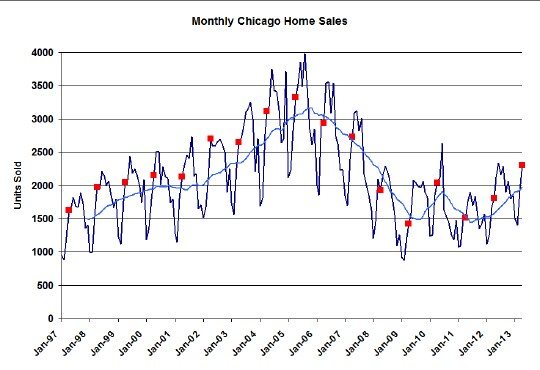
The Chicago real estate market continued to demonstrate it's incredible strength in April with home sales up 32.5% over the previous April. That's on top of last April's 19.4% increase and it's the 22nd month in a row of year over year home sale increases, confirming yet again that the Chicago real estate market is super hot.
In keeping with my usual caveat...when the Illinois Association of Realtors reports these numbers in 2 weeks they will be understating it as a 27.8% increase because they will be comparing preliminary 2013 numbers to final 2012 numbers for April. In addition you can expect them to make much ado about the increase in median prices, which hit at least a 2 year high of $221,700 or 21.8% above last year's $182,000. Just a reminder that this doesn't really mean much. It's certainly not an indication of the overall level of prices but rather an indication that the mix of homes sold is skewing decidedly upward. As I get into below there are far fewer distressed property sales than there have been in the past.
In general the growth in contract activity has been stronger than the growth in closings but every so often the backlog of pending home sales clears and results in surges like we just saw in April. Right now pending home sales is sitting at 7011, which is just a tad over a 3 month supply at April's sales rate.
From a high of 14.1 months back in January 2009 single family home inventory has dropped to 4.1 months in April. Meanwhile condo inventories, which peaked at 18.3 months, have now plummeted to a 3.1 month supply. And it just keeps on dropping.
If you want to keep up to date on the Chicago real estate market, get an insider's view of the seamy underbelly of the real estate industry, or you just think I'm the next Kurt Vonnegut you can Subscribe to Getting Real by Email.
The Chicago real estate market continued to demonstrate it's incredible strength in April with home sales up 32.5% over the previous April. That's on top of last April's 19.4% increase and it's the 22nd month in a row of year over year home sale increases, confirming yet again that the Chicago real estate market is super hot.
In keeping with my usual caveat...when the Illinois Association of Realtors reports these numbers in 2 weeks they will be understating it as a 27.8% increase because they will be comparing preliminary 2013 numbers to final 2012 numbers for April. In addition you can expect them to make much ado about the increase in median prices, which hit at least a 2 year high of $221,700 or 21.8% above last year's $182,000. Just a reminder that this doesn't really mean much. It's certainly not an indication of the overall level of prices but rather an indication that the mix of homes sold is skewing decidedly upward. As I get into below there are far fewer distressed property sales than there have been in the past.
April Chicago Home Sales
When you look at the long term graph of Chicago home sales by month below you can see that this April was the highest in 6 years. Furthermore, you will note that this is a level higher than that of 2001, which was actually the beginning of the housing bubble. On the one hand I would not expect us to hit the bubble levels any time soon unless we began another bubble. On the other hand though there is probably a lot of pent up demand sitting out there so we might still see some further increases over the next 12 months.Chicago Home Contract Activity
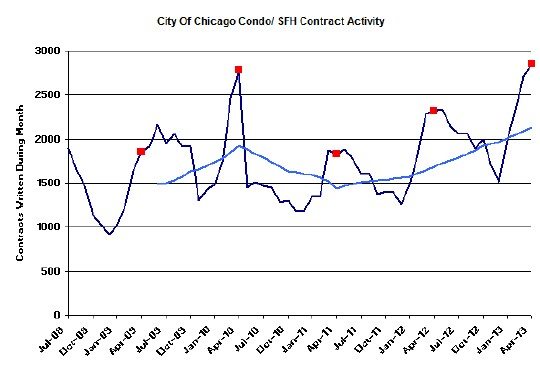
Contract activity, which is a leading indicator of home sales, continues to point in an extremely positive direction. I don't have that data as far back but as you can see in the graph below this April had the strongest contract activity in 5 years. This April was 22.6% above last year and the moving average, in blue below, continues to move upward.In general the growth in contract activity has been stronger than the growth in closings but every so often the backlog of pending home sales clears and results in surges like we just saw in April. Right now pending home sales is sitting at 7011, which is just a tad over a 3 month supply at April's sales rate.
Distressed Home Sales
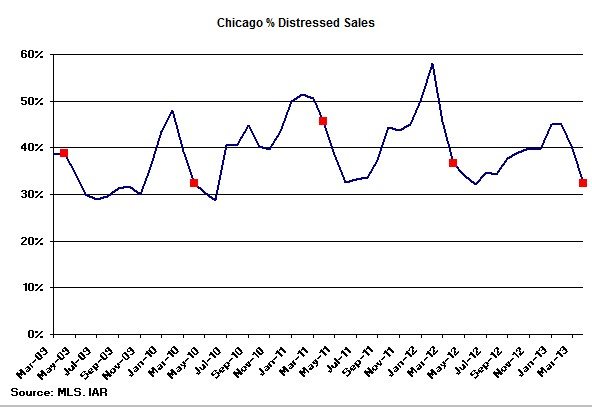
As I alluded to above the percentage of distressed home sales in Chicago has been trending downward. April hit the lowest level in 5 years, edging out 2010 by just a hair at 32.3%. This is what is driving the median price higher, not an overall increase in prices, though that is a contributing factor as well.Chicago Home Inventory
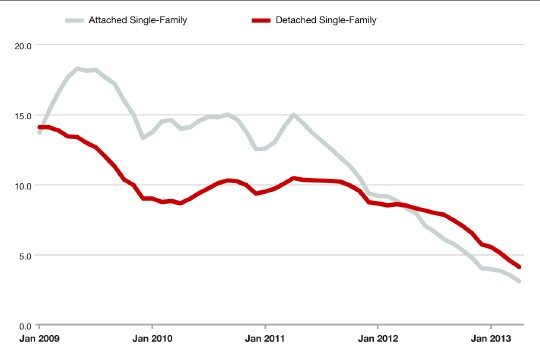
There is still a critical shortage of good home inventory in Chicago, making it extremely difficult for buyers to find anything decent. However, as you might expect, sellers and their agents are in great shape with properties selling in record times. Some listing agents are making a killing these days so keep that in mind when negotiating the selling commission (it is negotiable).From a high of 14.1 months back in January 2009 single family home inventory has dropped to 4.1 months in April. Meanwhile condo inventories, which peaked at 18.3 months, have now plummeted to a 3.1 month supply. And it just keeps on dropping.
If you want to keep up to date on the Chicago real estate market, get an insider's view of the seamy underbelly of the real estate industry, or you just think I'm the next Kurt Vonnegut you can Subscribe to Getting Real by Email.
Filed under: Foreclosures/ Short Sales, Market conditions
Tags: Chicago home sales, Chicago real estate market, market conditions
Tags: Chicago home sales, Chicago real estate market, market conditions
Subscribe to:
Comments (Atom)